Tokenization
What it is
Think of tokenization like a currency exchange before you enter a foreign market — you hand over raw text at the door and receive a sequence of numbered chips (token IDs) that the model's internal machinery actually understands.
Tokenization is the process of splitting raw text into subword units and mapping each unit to an integer ID from a fixed vocabulary, producing the integer sequence that a language model processes during training and inference. The model never sees characters or words — only those integers.
It is not simply splitting text on whitespace or punctuation. Subword tokenizers learn merge rules or probability scores from a training corpus and split words into fragments that balance vocabulary coverage with sequence length — meaning the same surface text maps to very different token sequences depending on which model's tokenizer you use.
How it works
The full pipeline
The 10-second mental model: raw text enters, an integer sequence exits, and four stages connect them.
Each integer ID is then looked up in an embedding table to produce a dense vector before it enters any transformer layer. → see Embeddings for what happens next.
The total number of tokens in a sequence determines how much of the context window the input consumes. → see Context window for how that budget is managed.
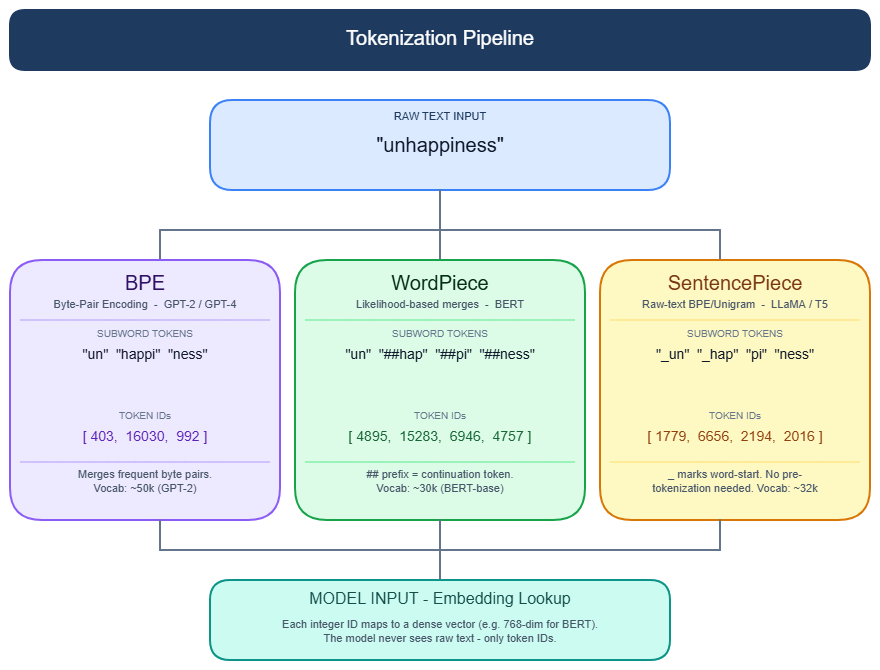
Stage 1: Pre-tokenization — the hidden layer
Before any subword algorithm runs, a regex-based pre-tokenizer splits raw text into coarse chunks. This step is rarely documented but is where many production surprises originate.
GPT-2's regex treats contractions as prefix patterns: 're, 've, 'll are matched as prefixes, so "really" splits as ["re", "ally"] in some positions because the pattern grabs "re" first. The regex is also case-sensitive: "HOW'S" splits differently from "how's". GPT-4 improved this, but every model family has its own rules.
GPT-4's pre-tokenizer groups consecutive spaces: up to 83 consecutive spaces become one token instead of one token per space. This matters for Python indentation — GPT-2-era tokenizers charged one token per space, making deeply indented code significantly more expensive.
SentencePiece takes a different approach: it treats whitespace as a regular character (▁) and needs no pre-tokenizer at all. "Hello world" becomes ["▁Hello", "▁world"]. This design is the only one that is truly language-agnostic.
Stage 2a: Byte Pair Encoding (BPE) — the dominant algorithm
BPE (Sennrich et al., 2016) is used by GPT-4, GPT-4o, Llama 3, Gemma, Qwen2, Mistral, and most other production LLMs. It was originally a data compression algorithm, adapted for subword segmentation.
Vocabulary construction (training):
- Pre-tokenize corpus into words with frequency counts:
("hug", 10), ("pug", 5), ("pun", 12). - Initialize vocabulary as all unique characters:
["b", "g", "h", "n", "p", "u"]. - Find the most-frequent adjacent pair across all words —
"u"+"g"appears 15 times — and merge it into a new token"ug". - Repeat until vocabulary reaches the target size (base characters plus N merges).
Inference: Apply the learned merge rules in training order. The process is deterministic — the same string always produces the same tokens with the same tokenizer.
Byte-level BPE starts from all 256 byte values instead of Unicode characters. This guarantees zero unknown tokens for any input, including emoji, code, and every script on earth. GPT-2, GPT-3, GPT-4, GPT-4o, and Llama 1/2 all use byte-level BPE.
Vocabulary sizes across models:
| Model | Algorithm | Vocab size | Tokens per English word |
|---|---|---|---|
| GPT-2 | Byte-level BPE | 50,257 | ~1.3 |
| GPT-4 (cl100k) | Byte-level BPE | 100,256 | ~1.1–1.2 |
| GPT-4o (o200k) | Byte-level BPE | ~200,000 | ~1.1 |
| Llama 2 | SentencePiece BPE | 32,000 | ~1.3 |
| Llama 3 (tiktoken) | BPE | 128,000 | ~1.2 |
| BERT-base | WordPiece | 30,522 | ~1.3 |
| T5 | SentencePiece Unigram | 32,000 | ~1.3 |
| mT5 | SentencePiece Unigram | 250,000 | (multilingual) |
1 token ≈ 4 bytes of English text (tiktoken docs rule of thumb).
Stage 2b: WordPiece — the BERT-family algorithm
WordPiece is used by BERT, DistilBERT, and Electra. The training procedure looks like BPE — bottom-up merges — but the merge criterion is different:
BPE selects:        pair with highest frequency("ug")
WordPiece selects:  pair with highest frequency("ug") / (frequency("u") × frequency("g"))
WordPiece prefers "informativeness" over raw frequency — it merges pairs that are surprising given each token's individual frequency. This produces more linguistically coherent splits. Tokens that continue a word (not the first piece) get a ## prefix: "hugging" → ["hugg", "##ing"]. BERT-base uses a 30,522-token vocabulary.
WordPiece is narrowly alive in encoder-only models. For any generative or decoder-based model, BPE is the operative algorithm.
Stage 2c: Unigram Language Model (SentencePiece) — the multilingual algorithm
Unigram (Kudo, 2018), implemented in the SentencePiece library, works top-down — the opposite of BPE.
Vocabulary construction:
- Start with a large candidate vocabulary (all substrings up to some length).
- Score each token by its contribution to corpus likelihood.
- Remove the lowest-impact 10–20% each round — tokens whose removal least reduces the model's ability to represent the corpus.
- Repeat until the target vocabulary size is reached.
At inference, Unigram is not deterministic: a string can have multiple valid tokenizations and the algorithm selects the highest-probability one via Viterbi decoding. During training, it can sample alternative tokenizations as data augmentation (subword regularization).
SentencePiece's language-agnostic design makes it the standard for multilingual models: T5 (32K tokens), mT5 (250K tokens), and XLNet all use it. The ▁ whitespace marker is the visual tell — if you see that character in a tokenizer's output, you are working with SentencePiece.
Recent evolution
Vocabulary size inflation (2024–2025): Larger vocabularies improve both multilingual coverage and context efficiency. Llama 3 grew from 32K to 128K tokens — a full retraining run was required because the vocabulary change breaks embedding weight compatibility. GPT-4o's o200k doubled GPT-4's cl100k. A NeurIPS 2024 paper identified 128K as approximately the optimal vocabulary size; returns diminish beyond that.
tiktoken as de facto standard: OpenAI's Rust-backed tiktoken is 3–6x faster than equivalent HuggingFace tokenizers. Llama 3's switch from SentencePiece to tiktoken signals convergence on a single high-performance implementation.
Meta's Byte Latent Transformer (BLT, December 2024): BLT groups raw bytes into variable-length patches based on entropy — no fixed vocabulary, no merge rules. At 8B parameters, BLT achieves 61.1% average benchmark score vs. Llama 3's 60.0%, using 50% fewer inference FLOPs. On character-level tasks (CUTE benchmark): 54.1 vs. Llama 3's 27.5. BLT proves that tokenization is not architecturally mandatory, but as of mid-2026 it has not displaced fixed-vocabulary tokenizers in production.
The LLM, SLM & Foundation Models overview covers how tokenization fits into the broader pretraining pipeline.
Gotchas & production behavior
Character-level reasoning failures
- LLMs fail at letter-counting and string reversal because the model never sees individual characters. "strawberry" tokenizes as
["st", "raw", "berry"]under GPT-4o — the two r's in "berry" are fused into one token. Asking "how many r's in strawberry?" yields 2, not 3. - Workaround: instruct the model to spell out the word with spaces (
"s t r a w b e r r y") before answering — this forces single-character tokens. Cost: roughly 5x more tokens than a direct question.
Arithmetic errors follow token boundaries, not math difficulty
- GPT-3.5 multi-digit addition accuracy: 75.6% with left-to-right tokenization, 97.8% with right-to-left. Claude 2.1: 28.3% L2R vs. 100% R2L. Error rates spike where a carry crosses a token boundary.
- Workaround: format numbers with comma separators in prompts (
"add 1,234,567 and 8,901,234") — this forces right-boundary splits at inference time. Anthropic adopted R2L integer tokenization in Claude 3, which is why Claude 3 Haiku outperformed GPT-4 on certain arithmetic benchmarks despite being a smaller model.
The multilingual token tax
- BPE trained on English-heavy corpora fragments non-Latin scripts into individual bytes. Arabic requires 68% more tokens than English in Qwen and 340% more in DeepSeek for equivalent text. African languages average 25 MMLU accuracy points below English on identical knowledge content.
- The cost equation is non-linear: 2x token fertility produces roughly 4x training cost due to O(n²) attention scaling. For multilingual applications, model selection should include tokenizer fertility as a primary criterion — Qwen tokenizers show the smallest inflation penalty for non-Latin scripts.
- Budget 2–3x more tokens per query for non-Latin scripts in cost estimates.
Duplicate BOS tokens silently corrupt fine-tuning
- When a chat template already injects a
<bos>token and you call the tokenizer withadd_special_tokens=True(the default), sequences start with two BOS tokens:[128000, 128000, ...]. Fine-tuning on this data produces models with degraded output quality — no error or warning is raised. - Workaround: pass
add_special_tokens=Falsewhen usingapply_chat_template(). Audit the chat template source directly. Models differ: Qwen2.5-0.5B has nobos_token; Llama-3.2 places EOS at sequence end; DBRX omits it entirely. There is no unified convention. (Source: vLLM issue #9519)
Fast vs. slow tokenizer implementations diverge
- HuggingFace maintains Python ("slow") and Rust ("fast") tokenizer implementations that produce different token IDs for the same input. LlamaTokenizer differs in its first token (token 2 vs. token 1 for identical prompts). Out-of-vocabulary behavior also diverges: slow tokenizers raise exceptions; fast tokenizers return silent empty strings.
- Workaround: pin
use_fast=Trueoruse_fast=Falseexplicitly, and use the same setting at training and inference time. (Source: HuggingFace transformers issues #23889, #29159)
Invisible Unicode characters break RAG retrieval
- U+200B (zero-width space), U+FEFF (byte order mark), and U+00AD (soft hyphen) are invisible to humans but create token splits that shift IDs and embedding vectors. A query that looks identical to indexed text fails to retrieve because one string was copy-pasted through a pipeline that injected a zero-width space.
- GPT-4's pre-tokenizer matches ASCII apostrophe (U+0027) but not the Unicode right single quotation mark (U+2019). Text typed on mobile or pasted from Word silently uses U+2019, producing a different tokenization for visually identical text.
- Workaround: apply
unicodedata.normalize('NFKC', text)before tokenization and strip Unicode category Cf (format characters). Tradeoff: NFKC normalization is lossy for multilingual text with valid ligatures or fullwidth characters.
Token count estimates using the wrong tokenizer are systematically wrong
- LiteLLM defaults to tiktoken for all token counting even when the model uses a different tokenizer (documented issue #8244). For Llama, Mistral, and Qwen models this produces wrong counts that corrupt rate-limit logic, cost budgets, and context window management.
- For any count that feeds into rate limits or context window calculations, always use the model's own tokenizer.
Perplexity benchmarks are not cross-tokenizer comparable
- A tokenizer producing 13.8% more tokens per document shows lower raw per-token perplexity for an identical-quality model — each token simply carries less burden. Mixtral models experience up to 21.6% perplexity inflation versus other models purely from tokenizer differences.
- Use bits-per-byte (BPB) or bits-per-character (BPC) for cross-model comparisons. Artificial Analysis normalizes all models to tiktoken o200k_base for this reason.
Prompt-boundary token healing
- About 70% of common BPE vocabulary tokens are prefixes of longer tokens. When a prompt ends mid-token, the model is blocked from generating the full token it would normally predict. Classic symptom: prompting with
"The url is http:"causes generation of"http: //www.google.com"with a spurious space because"://"is a single token but":"at the boundary signals that"//"is not the natural continuation. - Workaround: the
guidancelibrary implements "token healing" — backing up one token and regenerating with the prefix as a constraint. HuggingFace transformers has an open issue for this (#28346).
Why it matters
This topic sits at the Model serving layer — specifically at the entry point, before any attention computation or decoding. Every downstream decision in this section depends on tokenization outputs: context window consumption → Context window, autoregressive prediction over token IDs → Autoregressive decoding, and embedding vector quality → Embeddings.
Without understanding tokenization, you cannot diagnose why a model fails at arithmetic (token boundary effects), why multilingual costs are 2–5x your English estimates, why fine-tuned models produce degraded output with no error message (duplicate BOS), or why perplexity benchmarks comparing different models are misleading.
The concrete anchor: Llama 3's vocabulary expansion from 32K to 128K tokens required a full model retraining run — vocabulary changes are not hot-swappable. And that same change reduced token count for non-English text by 20–30%, directly reducing inference cost and improving multilingual reasoning quality.
Key terms
| Term | Meaning in this context |
|---|---|
| Token | The atomic unit of model input/output — a subword fragment mapped to a single integer ID in the vocabulary |
| Vocabulary | The fixed set of all token strings learned during tokenizer training; once frozen, adding new tokens requires retraining the model |
| BPE (Byte Pair Encoding) | A bottom-up merge algorithm that builds vocabulary by repeatedly fusing the most-frequent adjacent character pair; used by GPT-4, Llama 3, Mistral |
| Byte-level BPE | A BPE variant that starts from all 256 byte values instead of Unicode characters, guaranteeing zero unknown tokens for any input |
| WordPiece | A BPE variant that uses likelihood-based scoring instead of raw frequency; marks continuation pieces with ##; used by BERT-family models |
| Unigram / SentencePiece | A top-down pruning algorithm that starts with a large vocabulary and removes low-impact tokens; can produce multiple valid tokenizations; language-agnostic by design |
| Token fertility | The ratio of tokens to words (or characters) for a given language — high fertility means more tokens for equivalent content, increasing cost and reducing effective context |
| Pre-tokenizer | The regex layer that splits raw text into coarse chunks before any subword algorithm runs; source of many case-sensitivity and punctuation surprises |
| BOS / EOS tokens | Special beginning-of-sequence and end-of-sequence markers injected by the tokenizer; vary by model family with no unified convention |
| Token healing | Technique for backing up one token and regenerating with a prefix constraint when a prompt ends at a token boundary, preventing spurious character insertion |
Code / demo
# pip install tiktoken transformers
import tiktoken

# GPT-4o tokenizer
enc = tiktoken.get_encoding("o200k_base")

examples = [
    "Hello world!",
    "strawberry",        # character-counting trap
    "1234567 + 8901234", # arithmetic boundary trap
    "مرحبا بالعالم",     # Arabic: token fertility demo
]

for text in examples:
    ids = enc.encode(text)
    tokens = [enc.decode([i]) for i in ids]
    print(f"Text:   {text!r}")
    print(f"Tokens: {tokens}")
    print(f"IDs:    {ids}")
    print(f"Count:  {len(ids)} tokens")
    print()
Note: requires
pip install tiktoken. Runs without a GPU or API key.
Common fix — duplicate BOS prevention when using chat templates:
# Bad: may produce [128000, 128000, ...] for Llama-3 models
# tokens = tokenizer(text, add_special_tokens=True)

# Correct: let apply_chat_template handle special tokens
messages = [{"role": "user", "content": "Hello"}]
tokens = tokenizer.apply_chat_template(
    messages,
    add_special_tokens=False,  # template already includes BOS
    return_tensors="pt"
)
My notes
- The pre-tokenizer regex is the least-documented part of the pipeline and the source of the most confusing production bugs. GPT-4's regex improvement over GPT-2 is real, but the exact rules are not in the official docs — you have to read the tiktoken source.
- Multilingual token fertility is a first-order model selection criterion for any non-English application, not an afterthought. The 2–5x token expansion for African languages compounds into 4–25x training cost differences when attention scales quadratically — this is rarely mentioned in model comparison benchmarks.
- The fast vs. slow tokenizer divergence (HuggingFace issues #23889, #29159) is particularly dangerous because the difference shows up silently at fine-tuning time and produces models that perform worse without any error. This deserves explicit CI testing.
- BLT's 50% inference FLOP reduction at matched accuracy is the most credible challenge to fixed-vocabulary tokenization yet. The open question is whether byte-patch architectures can scale to 70B+ parameters at competitive training cost — the 8B results are promising but not conclusive.
- The "token tax" formalization (arXiv:2509.05486) quantified that fertility explains 20–50% of accuracy variance across non-English languages — which means improving the tokenizer alone, without changing the model, can close a measurable fraction of the multilingual performance gap.
Last researched: 2026-05-18
Resources
- Sennrich et al. (2016) — "Neural Machine Translation of Rare Words with Subword Units" — the original BPE-for-NLP paper: https://arxiv.org/abs/1508.07909
- HuggingFace Tokenizer Summary — covers BPE, WordPiece, Unigram, and SentencePiece with worked examples: https://huggingface.co/docs/transformers/en/tokenizer_summary
- Meta BLT (2024) — "Byte Latent Transformer: Patches Scale Better Than Tokens" — the tokenization-free architecture paper: https://arxiv.org/abs/2412.09871