Transformer architecture
What it is
Think of a transformer like a document review committee where every reviewer can instantly read and cross-reference every part of the document simultaneously — rather than reading it word by word from left to right the way a human editor would.
A transformer is a neural network architecture built from a stack of identical blocks, each combining a self-attention sublayer (which routes information between token positions) and a feed-forward network sublayer (which processes each position independently), connected by residual connections and layer normalization.
It is not a single architecture — the term covers three distinct variants (encoder-only, decoder-only, and encoder-decoder) that share a block structure but differ fundamentally in what their attention layers are allowed to see and in whether they can generate text autoregressively.
How it works
The three variants
Every transformer variant is built from the same four primitives repeated across N layers: self-attention, a feed-forward network (FFN), layer normalization, and residual connections. What distinguishes the variants is the attention mask and the presence or absence of cross-attention.
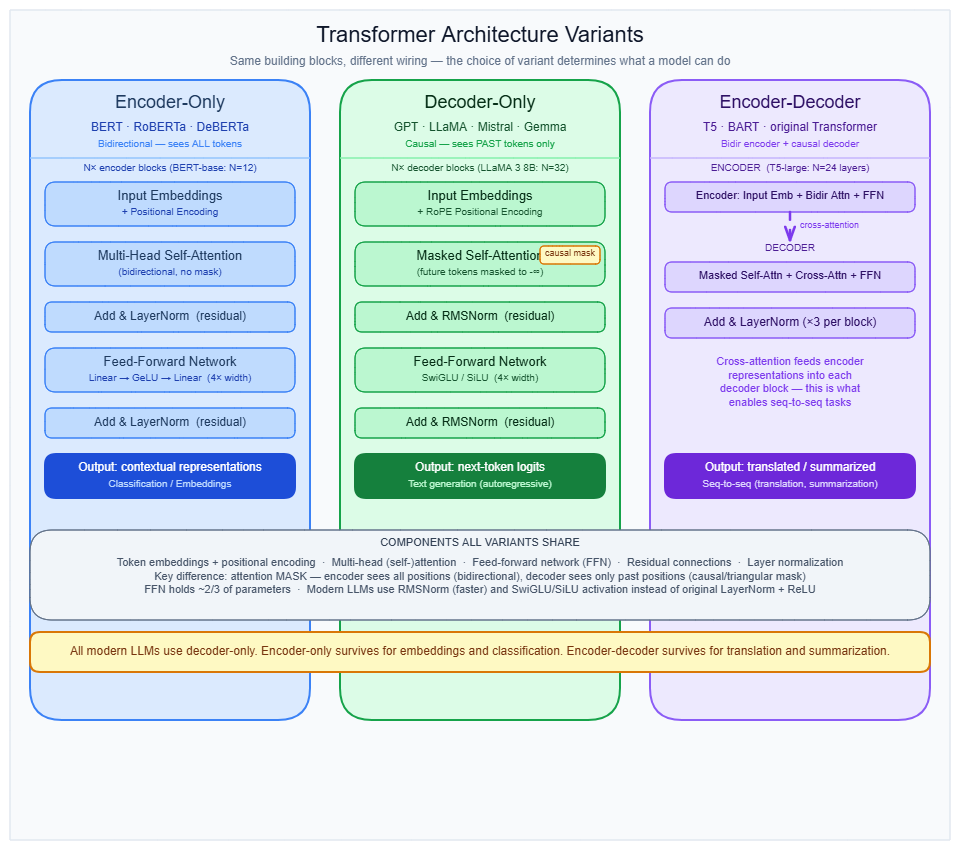
Encoder-only (BERT, RoBERTa, ModernBERT)
Every token in the input attends to every other token — past and future — simultaneously. This bidirectional attention produces a sequence of contextualized hidden states, one per input token, that are then passed to a task-specific head for classification, tagging, or embedding extraction. Encoder-only models cannot generate text autoregressively — they have no causal structure. They are the right tool for classification, named entity recognition, semantic search, and embedding generation where labeled data is available.
BERT-base: 12 layers, d_model = 768, d_ff = 3,072, 12 attention heads, 110M parameters. BERT-large: 24 layers, d_model = 1,024, d_ff = 4,096, 16 heads, 340M parameters.
Decoder-only (GPT, LLaMA, Mistral, DeepSeek, Gemma)
Each token can only attend to itself and tokens that came before it. This causal (masked) self-attention is enforced by a triangular mask applied to the attention score matrix before softmax — all future positions are set to -inf and vanish after softmax. There is no cross-attention sublayer. This structure makes decoder-only models the correct choice for autoregressive text generation.
LLaMA 3 8B: 32 layers, d_model = 4,096, 32 query heads / 8 KV heads (GQA), 8B parameters. LLaMA 3 70B: 80 layers, d_model = 8,192, 64 query heads / 8 KV heads, 70B parameters. GPT-3: 96 layers, d_model = 12,288, 175B parameters.
→ see Autoregressive decoding for how the causal mask enables token-by-token generation.
Encoder-decoder (T5, BART, original 2017 Transformer)
The encoder stack processes the full input with bidirectional attention, producing a sequence of hidden states. The decoder stack then generates output autoregressively using two attention sublayers per block: causal self-attention over the partially generated output, plus cross-attention where decoder queries attend over all encoder output states. That cross-attention connection is how the decoder accesses the encoded input at every generation step. The extra sublayer makes encoder-decoder decoder blocks roughly 50% more expensive per layer than decoder-only blocks. This architecture retains a niche in structured sequence-to-sequence tasks (translation, summarization with structured output, code generation from formal specs).
Original 2017 model: 6 encoder + 6 decoder layers, d_model = 512, d_ff = 2,048, 8 heads.
Forward pass through one decoder block
What each block component does
Self-attention sublayer routes information between token positions by computing compatibility scores between every pair of positions in the sequence. → see Attention mechanism for the Q, K, V projection mechanics and scaled dot-product computation.
Feed-forward network (FFN) sublayer applies the same two-layer fully connected network independently to each token position. It does not exchange information between positions — it deepens each position's representation in isolation. The original transformer used ReLU activation with d_ff = 4 × d_model, giving an FFN expansion ratio of 4. Modern LLMs use SwiGLU activation, which shifts the expansion ratio to (8/3) × d_model but adds a gating projection, keeping total parameters similar.
Layer normalization stabilizes activations. The original paper applied normalization after each sublayer (post-norm). Post-norm became dominant in BERT but was replaced by pre-norm (applying normalization to the input of each sublayer) in GPT-2 onward because pre-norm prevents gradient explosion in very deep models and trains stably without mandatory warmup schedules. As of 2025, ~77.4% of models use RMSNorm (a simpler variant of LayerNorm with no mean-centering).
Residual connections wrap every sublayer: output = x + SubLayer(x). Gradients flow directly back through the network without passing through the sublayer computation, which is what makes 96+ layer models trainable. The more accurate mental model: the layers are writing refinements (deltas) to a shared residual stream that passes through largely unchanged — not transforming the representation wholesale at every step.
Parameter distribution: where the weights actually live
The title "Attention Is All You Need" creates a persistent wrong intuition. In practice, the FFN sublayer holds roughly twice the parameters of the self-attention sublayer per layer.
Per-layer parameter counts at d_model = d (approximate):
- Multi-head attention (Q, K, V, O projections): ≈ 4d²
- FFN (two linear layers with 4× expansion): ≈ 8d²
- FFN:attention ratio ≈ 2:1
In LLaMA 3 8B across all 32 layers:
- Attention parameters: ~1,344M (~17% of total)
- FFN parameters: ~5,632M (~70% of total)
- Embedding + output head: ~13%
This has direct implications for compression work: pruning attention aggressively while leaving FFN intact misses the dominant parameter mass. → see Attention mechanism for per-head parameter breakdowns.
Modern evolution (2023–2025)
Grouped-query attention (GQA) — now universal: Standard multi-head attention allocates one set of key-value pairs per query head. GQA groups multiple query heads to share a single KV head, reducing KV cache memory proportionally. LLaMA 3 8B uses 32 query heads sharing 8 KV heads (4:1 ratio), cutting KV cache size by 4× with negligible accuracy loss. GQA is now the de facto standard. → see KV cache for how this affects memory allocation at inference.
Multi-head latent attention (MLA) — DeepSeek V2/V3 (2024): MLA compresses the key-value representation into a low-dimensional latent vector (dimension d_c ≪ n_h × d_h). Only this latent vector is stored in the cache and expanded back during attention computation. At 68.75% KV compression: -0.29% performance loss. At 87.5% compression: modest further degradation. MLA is appearing in Kimi K2, GLM-5, and other 2025 architectures.
RoPE positional encoding — 69.8% adoption: Rotary position embedding (RoPE) encodes position by rotating the query and key vectors in attention by a position-dependent angle, rather than adding a sinusoidal offset to the embedding. This enables better length extrapolation than the original sinusoidal encoding, though reliable extension to contexts beyond training still requires explicit methods like YaRN. → see Context window for how positional encoding limits and extensions interact with generation.
SwiGLU activation — 71.7% adoption: SwiGLU replaces ReLU in the FFN with a gated linear unit: SwiGLU(x, W, V) = Swish(xW) ⊙ (xV). The gating mechanism provides smoother gradients and consistently outperforms GeLU and ReLU at the same parameter count.
Hybrid transformer + SSM (2024–2025): State Space Models (Mamba/Mamba-2) process sequences in linear time with no KV cache. NVIDIA's Nemotron-H replaces 92% of attention layers with Mamba-2 blocks, achieving up to 3× higher throughput at long contexts. AI21's Jamba combines Mamba, transformer, and mixture-of-experts (MoE) layers for 256K context windows. This is an active research front, not yet production-settled.
Post-norm revisited: Five years of pre-norm dominance is being challenged. OLMo 2 and Gemma 3 return to post-norm paired with QK-normalization (normalizing query and key vectors before attention) to prevent logit explosion at depth, claiming better training stability at scale. Whether this trend continues is unresolved as of May 2026.
What the 2017 paper got right and wrong
| Component | 2017 original | 2025 default |
|---|---|---|
| Positional encoding | Sinusoidal (absolute) | RoPE (relative, rotary) |
| Normalization placement | Post-norm | Pre-norm (RMSNorm) |
| FFN activation | ReLU | SwiGLU |
| Generative architecture | Encoder-decoder | Decoder-only |
| Residual connection structure | Retained unchanged | Retained unchanged |
| Multi-head attention concept | Retained (adapted to GQA/MLA) | Retained (adapted) |
| Alternating attention-FFN blocks | Retained unchanged | Retained unchanged |
The residual connection structure, the multi-head attention concept, and the alternating attention-FFN block pattern survived intact. Everything else was replaced.
Gotchas & production behavior
Model selection pitfalls
- Encoder-only for generation, decoder-only for classification. BERT cannot generate text — it produces bidirectional representations with no causal ordering. Using a GPT-style decoder for classification when you have 500+ labeled samples wastes compute: fine-tuned BERT achieves ~57.6% accuracy on text classification vs ~18% from prompting a decoder-only model zero-shot on the same task. The rule: if you have labels, use an encoder; if you're generating, use a decoder.
- "Decoder-only won because it's architecturally superior." The actual driver was the shift to instruction-following — encoder-decoder required per-task classification heads, decoder-only simplified fine-tuning to a single objective. When compute is held constant and instruction tuning is applied, encoder-decoder matches or exceeds decoder-only (RedLLM 8B: 59.69 vs DecLLM 58.26 zero-shot). The architectural victory was cultural, not empirical.
Depth and width allocation pitfalls
- "More layers = better." Research shows optimal hidden dimension width grows 2.8× faster than depth. At 7B scale, a 64-layer model (6.38B params) underperforms a 32-layer model (6.86B params) by 0.12 nats — strictly worse despite more layers. Around 50% of layers in deep pre-norm models are near-identity in practice. Prefer adding width before adding layers once you are past 32 layers. Never use layer count as a proxy for model quality.
- Layer count in model names is not standardized. A "32-layer" model in one family may use different d_model, heads, and GQA configurations than a "32-layer" in another. Always look at d_model and active parameters, not layer count alone.
Normalization placement pitfalls
- Swapping pre-norm and post-norm configs is not cosmetic. Post-norm (BERT, original Transformer) requires a mandatory learning rate warmup — without it, training diverges from gradient explosion. Pre-norm (LLaMA, Mistral) is stable without warmup. Copying a modern LLaMA config into a post-norm architecture and omitting warmup produces silent training failures that may not surface until after hours of compute.
- Adding QK-normalization for deep models. At depths beyond 30 layers with post-norm, attention logits can explode. QK-norm (normalizing Q and K vectors before the dot product) prevents this. It appeared in Gemma and is required when reviving post-norm at scale.
FFN parameter mass is ignored during compression
- Practitioners focus on attention heads during pruning and quantization because of the paper's name and the conceptual prominence of attention. FFN parameters outnumber MHA parameters at ~2:1 per layer. In GPT-2: MHA ≈ 2.36M parameters per layer; FFN ≈ 4.7M per layer. Token embeddings ≈ 38.6M total — nearly matching all attention parameters combined across the whole model. Compute the FFN-vs-attention ratio explicitly before any compression work.
Residual stream mental model
- The common description ("residual connections add back what the layer missed") produces wrong intuitions about pruning. The accurate model: layers write small deltas to a shared residual stream that passes through largely unchanged. This explains why removing individual layers produces small quality drops — any single layer's contribution is marginal — and why gradient flow stays healthy in 100+ layer models.
Why it matters
This topic sits at the Model serving layer and is the structural prerequisite for every topic in section 01. Without knowing which transformer variant is in use — encoder-only, decoder-only, or encoder-decoder — the downstream decisions in this section (KV cache sizing, batching strategy, attention mechanism choice, context window limits) are made without a coherent model of the system being optimized.
The parameter distribution fact alone has direct dollar consequences: a quantization pass that compresses attention from FP16 to INT4 while leaving FFN at FP16 reduces total model size by roughly 17%, not 50%. In a 70B model, that gap is tens of gigabytes of VRAM that an engineer might have incorrectly planned away.
The concrete anchor: LLaMA 3 8B's GQA configuration (32 query heads, 8 KV heads) reduces KV cache memory by 4× compared to full multi-head attention — directly determining whether a 100K-token context fits on a single A100 or requires multi-GPU serving.
Key terms
| Term | Meaning |
|---|---|
| Encoder-only | Transformer variant where every token attends to every other token bidirectionally; produces contextualized representations, cannot generate autoregressively |
| Decoder-only | Transformer variant using causal (masked) self-attention; each token sees only prior tokens; the dominant architecture for generative LLMs |
| Encoder-decoder | Transformer variant with a bidirectional encoder stack and a separate autoregressive decoder stack connected via cross-attention |
| Causal mask | Triangular mask applied to attention scores that sets future-position scores to -inf, preventing each token from attending to tokens not yet generated |
| Residual stream | The vector that passes through all N transformer layers, with each sublayer writing a small delta rather than transforming it wholesale |
| Pre-norm | Layer normalization applied to the input of each sublayer (before attention or FFN), the dominant configuration since GPT-2; stable without warmup |
| Post-norm | Layer normalization applied to the output of each sublayer (after adding the residual); requires warmup to avoid gradient explosion |
| GQA (Grouped-query attention) | Attention variant where multiple query heads share one KV head, reducing KV cache size proportionally; standard since LLaMA 2 |
| MLA (Multi-head latent attention) | DeepSeek's KV compression technique: caches a low-dimensional latent vector per layer instead of full KV heads; 68–88% KV reduction |
| SwiGLU | Gated activation function used in modern FFN sublayers: Swish(xW) ⊙ (xV); adopted in LLaMA, Mistral, and ~72% of 2025 models |
Code / demo
The snippet below calculates the parameter count for the attention and FFN sublayers of a single transformer block given d_model and the expansion ratio, then shows the FFN:attention ratio. No GPU or API key required.
# No pip install needed — standard library only

def block_params(d_model, n_heads, n_kv_heads=None, ffn_expansion=4.0):
    if n_kv_heads is None:
        n_kv_heads = n_heads
    d_head = d_model // n_heads
    attn = (d_model * n_heads * d_head       # Q
            + d_model * n_kv_heads * d_head  # K
            + d_model * n_kv_heads * d_head  # V
            + n_heads * d_head * d_model)    # O
    d_ff = int(ffn_expansion * d_model)
    ffn = d_model * d_ff + d_ff * d_model
    return attn, ffn, round(ffn / attn, 2)

configs = [
    ("BERT-base",   768,  12, None, 4.0),
    ("LLaMA 3 8B", 4096,  32,    8, 8/3),  # SwiGLU expansion ratio
]

print(f"{'Model':<14} {'Attn params':>14} {'FFN params':>14} {'FFN:Attn':>10}")
print("-" * 56)
for name, d, nh, nkv, exp in configs:
    attn, ffn, ratio = block_params(d, nh, nkv, exp)
    print(f"{name:<14} {attn:>14,} {ffn:>14,} {ratio:>10.2f}")
Expected output:
Model          Attn params     FFN params   FFN:Attn
--------------------------------------------------------
BERT-base        2,359,296      4,718,592       2.00
LLaMA 3 8B      18,874,368     45,088,768       2.39
My notes
- The post-norm vs pre-norm debate is not settled. OLMo 2 and Gemma 3 are actively revisiting post-norm with QK-normalization, arguing it achieves better training stability at scale than pre-norm. Five years of consensus is being challenged — worth watching over the next 12 months.
- Encoder-decoder models may be underused for long-context tasks. The research shows they extrapolate to longer contexts better than decoder-only, and match decoder-only quality when instruction-tuned with equal compute. The industry shift to decoder-only was driven by the GPT cultural moment, not a clean empirical victory.
- The "residual stream as shared memory" mental model (layers write deltas, not transformations) changes how you reason about layer pruning. A layer that appears near-identity isn't broken — it's doing very little, which is why removing it hurts minimally. About 50% of layers in deep pre-norm models are near-identity; this is normal and expected behavior.
- GQA is now table stakes for any new decoder-only model, but the KV head count is a tunable hyperparameter that interacts directly with both quality and cache memory. Engineers often accept the published ratio (e.g., 4:1) without evaluating whether their serving context length and batch size would benefit from a different ratio. → see KV cache for the memory arithmetic.
- Hybrid SSM + transformer architectures (Nemotron-H, Jamba) claim 3× throughput improvements at long contexts. These are early production numbers on specific workloads — not yet generalizable benchmarks. The tradeoff is that SSM layers lack the KV cache interpretability tools and may behave differently during speculative decoding.
Last researched: May 2026
Resources
- Vaswani et al., "Attention Is All You Need" (2017) — https://arxiv.org/abs/1706.03762
- "The Crystallization of Transformer Architectures (2017–2025)" — a 53-model empirical analysis of which design choices survived — https://jytan.net/blog/2025/transformer-architectures/
- "Towards Economical Inference: MLA in Any Transformer-based LLMs" (2025) — https://arxiv.org/abs/2502.14837